Anna Julia Cooper: A saint who walked among us
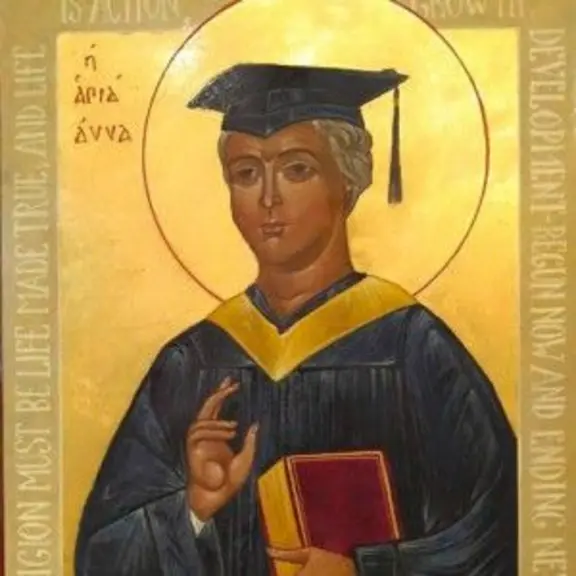
The commemoration of Anna Julia Cooper was provisionally approved by General Convention for inclusion in the Episcopal liturgical calendar in 2006. Her feast day is February 28th. Anna Julia Cooper was an African-American educator, scholar, and advocate whose remarkable life spanned from the last years of slavery to the Civil Rights era in the mid-20th century. She was also briefly a parishioner at Grace Episcopal Church.
Anna Julia Haywood was born into slavery in 1858 in Raleigh, North Carolina, to Hannah Stanley Haywood, a slave in the home of landowner and attorney George Washington Haywood. Historians believe Haywood was the father of Hannah's seven daughters.
In 1868, Anna received a scholarship to enter the inaugural class at St. Augustine’s Normal School and Collegiate Institute in Raleigh (now St. Augustine’s College), a school created by the local Episcopal Diocese to train African-American teachers and clergy. At St. Augustine's, she distinguished herself as a “bright and ambitious” student who showed promise in both liberal arts and math and science. In her schooling and later during her university training, Cooper fought for her right to take courses, such as Greek, which were reserved for men, by demonstrating her academic ability. Cooper began her teaching career early, helping pay for her expenses at St. Augustine by tutoring younger students. She stayed on at the school as an instructor after completing her studies.
In 1877, Anna married her former Greek instructor, George A. C. Cooper, the second African-American ordained to the Episcopal priesthood in North Carolina. After her husband's death in 1879, she enrolled in Oberlin College and became the first African-American woman to graduate from the school in 1884. She earned an M.A. in mathematics in 1887 and that year she was invited to teach math and science at the Preparatory High School for Colored Youth (later known as M Street and today as Dunbar High School) in Washington, D.C., the largest and most prestigious public high school for African-Americans in the nation.
Anna Julia Cooper had a long and successful career as a teacher, public speaker, author, and school administrator and was an early and vocal advocate of equal rights for blacks and women. Her groundbreaking book of essays A Voice from the South by a Black Woman of the South published in 1892 touched on a variety of topics, from racism and the socioeconomic realities of black families to the administration of the Episcopal Church. In 1925, at the age of 65 when she was awarded a Ph.D. from the University of Paris, she became only the fourth black woman in the United States to receive a doctorate degree. She retired as president of Frelinghuysen University in 1940 but continued to serve the university in other ways into her 90s. She died in 1964 at the age of 105.
Cooper's life was not without controversy and she was dismissed as principal at M Street High School in 1906, likely a result of being in the crosshairs of early 20th-century American race politics. As a consequence, from about 1908 to 1911 – sometimes called a period of “exile” by her biographers – she was on the faculty of Lincoln Institute in Jefferson City. Not much is known about her years in Jefferson City but we were thrilled to find her listed in the Grace Church parish register.
In the Episcopal Church, we believe that all baptized Christians are members of the communion of saints and have the potential to be examples of faith to others. Still, I find it rather touching to have an officially recognized “saint” who walked a short distance of her long life's journey here at Grace. Perhaps it gives us a special responsibility or calling to remember her life and work.
Today Anna Julia Cooper's quote "The cause of freedom is not the cause of a race or a sect, a party or a class – it is the cause of humankind, the very birthright of humanity" can be found in the pages of every U.S. passport. These remarkable words written more than a century ago by a remarkable woman – one of our very own saints – deserve to be remembered, honored, and embraced.
— Robyn Burnett